The customer
CIUSSS de l’Estrie–CHUS operates several critical healthcare facilities, including Hôtel-Dieu de Sherbrooke, where continuity of care and patient safety are priorities.

Customer story | Healthcare and hospital services

Summary
CIUSSS de l’Estrie–CHUS operates several critical healthcare facilities, including Hôtel-Dieu de Sherbrooke, where continuity of care and patient safety are priorities.
A sprinkler burst during extreme cold, forcing patient relocations and disrupting operations in a critical area of Hôtel-Dieu de Sherbrooke.
85 rooms documented, dried and validated. Affected areas returned to service in under two weeks, without demolition.
The organization
An essential part of Quebec’s healthcare network
CIUSSS de l’Estrie–CHUS delivers health services across many facilities in the region, including Hôtel-Dieu de Sherbrooke. In these critical environments, every interruption can directly affect continuity of care, patient safety and team operations.
A sprinkler burst during extreme cold caused major water damage on the ground floor of Hôtel-Dieu de Sherbrooke. The incident closed one emergency-area section, partially closed another and required patients to be relocated, disrupting normal operations.
CIUSSS needed to restore the affected spaces quickly while meeting the demanding standards of a care environment. Assek Technologies was asked to document the damage, dry the affected areas, validate results and support a safe return to clinical activities.
The challenges
Following an extreme cold spell, reaching −48 °C with wind chill, two sprinklers burst at Hôtel-Dieu de Sherbrooke. Part of the ground floor and critical areas were affected. One emergency section had to close, another was partially closed and patients were relocated to a temporary site on the fifth floor. Several medical appointments also had to be postponed while clinical activities were reorganized.
In a hospital, the challenge extends beyond drying. Through rigorous validation and complete documentation, the intervention had to demonstrate that the spaces could be safely reoccupied so clinical activities could resume quickly.
Limit impacts on patients and teams, then return areas to service as quickly as possible.
Meet the stringent requirements of a hospital setting before any reoccupation.
Confirm conditions in affected areas using technical data and independent microbiological analyses.
Provide the information needed to support return-to-service decisions.
The solution
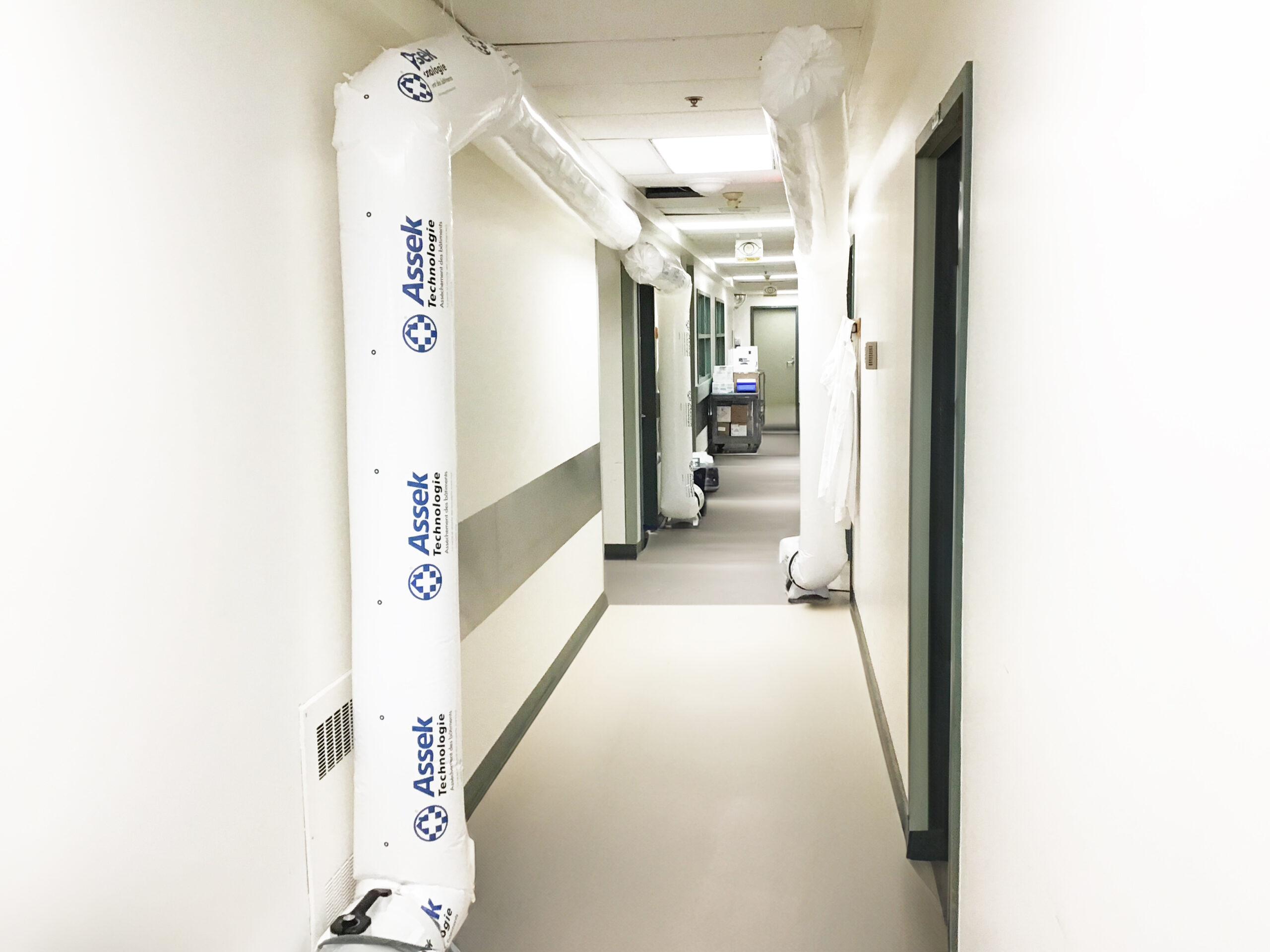
Assek Technologies deployed a structured approach combining assessment, non-destructive drying, result validation and complete documentation. The goal was to restore the spaces as quickly as possible while respecting the requirements of a care environment.
The intervention began with a detailed assessment of affected areas to document the extent of the damage and establish a suitable drying strategy. The work was coordinated with CIUSSS teams to limit operational impacts and support the progressive reoccupation of spaces.

A detailed assessment of affected areas using infrared thermography, moisture readings and psychrometric monitoring.
Controlled drying of recoverable materials to limit demolition, reconstruction and operational disruption.

A complete technical file documenting the intervention, validations and results.

The results
Using Assek Technologies’ non-destructive drying approach, CIUSSS de l’Estrie–CHUS returned the affected areas of Hôtel-Dieu de Sherbrooke to service in under two weeks after the incident. The intervention limited operational impacts, preserved recoverable materials and enabled rigorous validation before reoccupation.
Continuous monitoring of environmental conditions, controlled drying and independent microbiological validation provided the data needed to support a safe return to activities.
“As a CIUSSS de l’Estrie–CHUS manager, I have dealt with several water-damage events, including some in critical areas that could not be closed. Assek Technologies’ non-destructive drying solution was perfectly suited to our needs. Their ability to respond quickly without disrupting activities, while complying with infection-prevention and control standards, was a major asset.”
Manager, CIUSSS de l’Estrie–CHUS
Documented, dried and validated.
Critical areas restored after the incident.
Completed by an independent resource.
At the end of the work.
From the incident to return to service.
Final validation
Affected areas were monitored continuously using humidity sensors, psychrometric readings and thermographic inspections.
Data confirmed that materials returned below the target threshold of 15% wood moisture equivalent (WME).
Independent microbiological analyses confirmed the absence of contamination associated with the water-damage event.
Microbiological and technical validations supported the decision to reoccupy the spaces.
Final validation met the requirements of INSPQ, Health Canada, IICRC and CSA-Z317.13-12.
Let’s talk.