Industry | Healthcare facilities

Healthcare Facilities

How can you dry and protect a healthcare facility after water damage without interrupting quality of care?

Testimonials

A rigorous response without disrupting operations

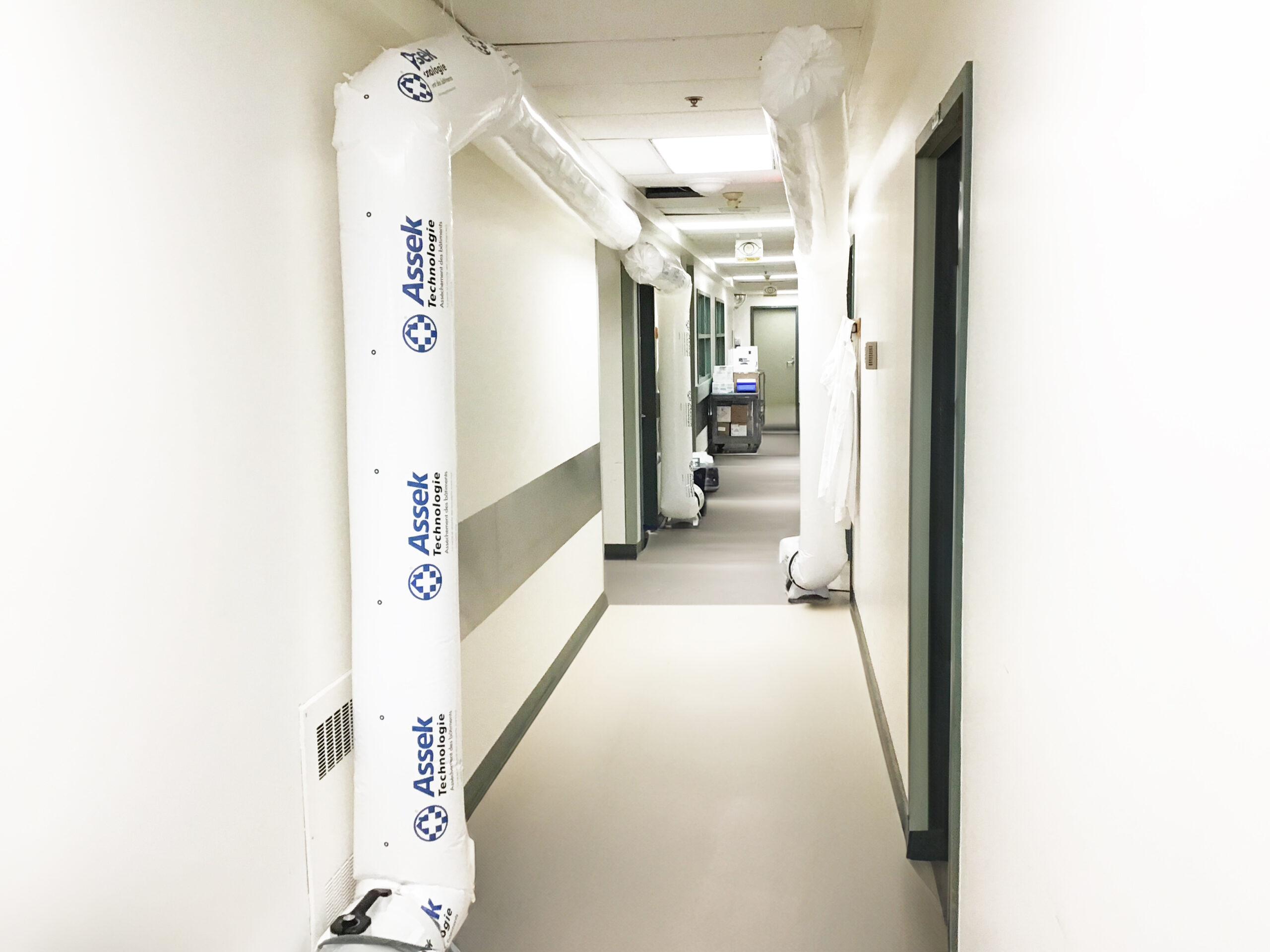
As a manager at CIUSSS de l'Estrie-CHUS, I have dealt with several water damage incidents, including some in critical areas that could not be closed. Assek Technologies' non-destructive drying solution proved well suited to our needs. Their ability to respond quickly without disrupting operations, while respecting infection-prevention and control requirements, was a major asset.

Manager of Material Resources, CIUSSS de l'Estrie-CHUS

In a hospital, every response begins with a rigorous assessment: thermography, humidity measurements, and an expert report, before drying is even considered. We also rely on environmental control and our Secur platform so the facility team has real-time visibility into each room's condition from the beginning to case closure.

Daniel Bouchard, Project Manager, Assek Technologies

These clients trust us

Why Assek

Why choose Assek for healthcare facility projects?

Solutions designed to support continuity of care, rigorous response, and clear visibility for teams.

Challenge

A critical area cannot always close

Water damage can affect rooms where continuity of care, patient safety, and infection-prevention and control requirements remain priorities.

Assek benefit

Respond with rigour and coordination

Assessment, non-destructive drying, temporary containment, and environmental-condition monitoring are adapted to the context of each room.

Challenge

Every decision needs to be traceable

Teams need to follow the condition of each room, document validation, and support return-to-service decisions.

Assek benefit

Keep a complete record

Secur brings together data, history, and the information needed to support response and re-entry decisions.

Challenge

Risks are spread across several facilities

Within a health authority, information can be scattered among buildings, teams, and active responses.

Assek benefit

Maintain an overall view

Sensors and Oblik make alerts, conditions, and responses visible in one place.

FAQ

Yes. An approach that combines temporary containment with continuous monitoring of pressure and HVAC conditions can often allow affected rooms to be treated while adjacent functional units remain in operation.

Guidance from the INSPQ, Health Canada, the IICRC, and CSA Z317.13-12 informs microbiological and technical validation before spaces return to service, including areas used for medical device reprocessing.

Temporary containment with an anteroom, combined with continuous differential-pressure monitoring, can help maintain the required respiratory or protective isolation conditions during the response.

The timeline depends on the extent of the damage. A structured response can nevertheless support a return to operations in one to two weeks, even when several dozen rooms are affected.

Do you have a current or upcoming project? Let's talk about it!